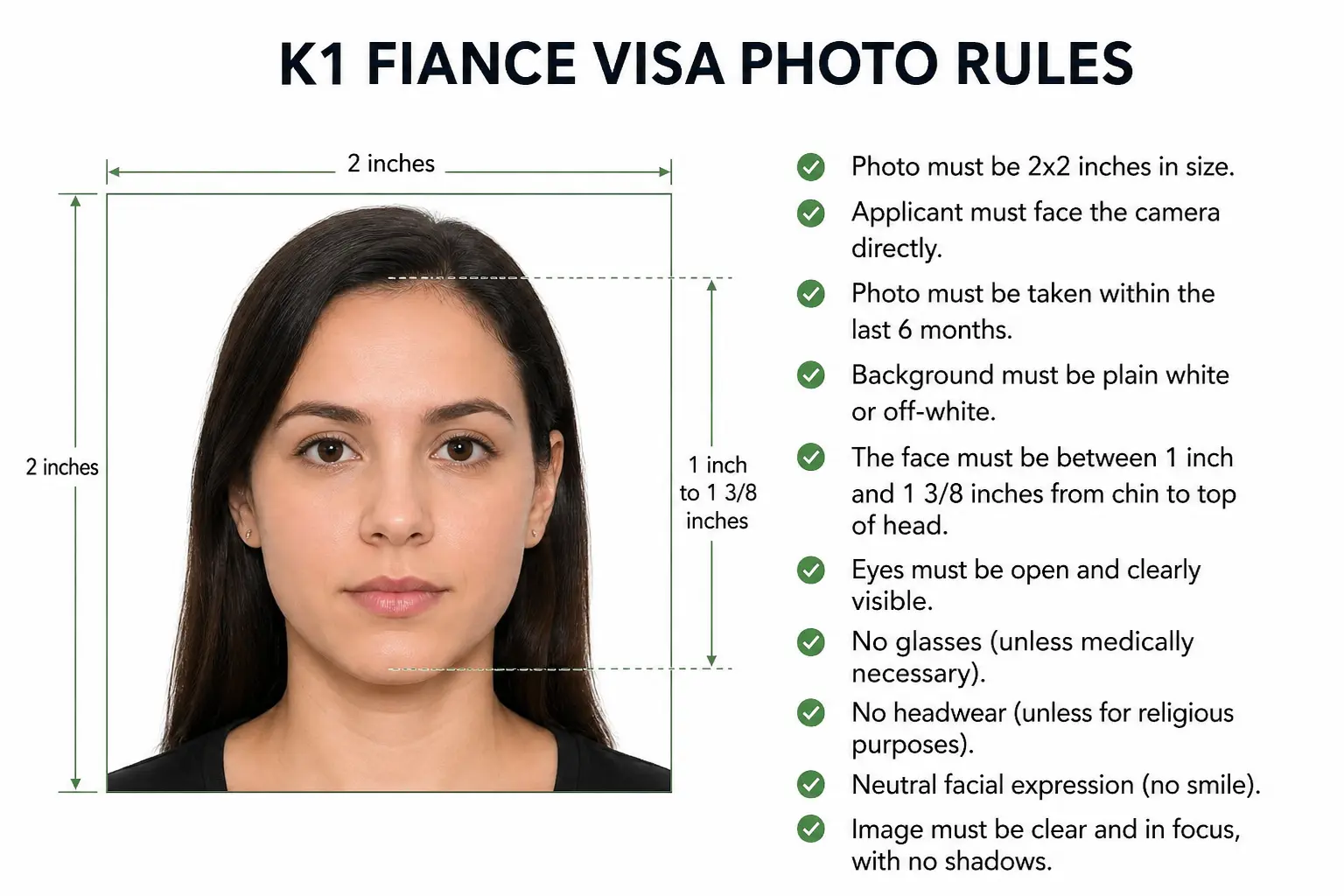
K1 Fiance Visa Photos in 2026 — Why There Are Three Separate Requirements
The K1 fiance visa — formally the Nonimmigrant Visa for a Fiancé(e), Form K-1 — is unique among US visa categories because it involves two separate federal agencies, each with its own photo requirements, across a multi-stage process that averages 10 to 16 months from start to finish in 2026. A photo error at any stage can trigger a Request for Evidence (RFE) from USCIS or cause your embassy interview to be delayed or rescheduled. Understanding exactly which photos are required at each stage — and the precise technical specifications — is essential.
The three distinct photo requirements are: (1) passport-style printed identity photos with the Form I-129F petition to USCIS, (2) a digital photo uploaded through the DS-160 online application at ceac.state.gov by the foreign fiancé(e), and (3) two printed passport-style photos brought to the US Embassy or Consulate interview. Additionally, relationship evidence photos — a completely different category with different rules — must be included in the I-129F package to prove the couple has met in person within the required two-year window. Each requirement is governed by official USCIS or US Department of State guidance.
| Stage | Who Submits | Photo Type | Quantity | Agency |
|---|---|---|---|---|
| I-129F Petition | US citizen petitioner AND foreign fiancé(e) | 2×2 inch (51×51mm) printed photo | 1 of each person | USCIS — uscis.gov |
| DS-160 Online Application | Foreign fiancé(e) only | Digital JPEG upload 600–1200px square | 1 digital file | Dept. of State — ceac.state.gov |
| Embassy Interview | Foreign fiancé(e) only | 2×2 inch (51×51mm) printed photos | 2 identical prints | Dept. of State — travel.state.gov |
| Relationship Evidence | US citizen (included in I-129F) | Photos of couple together in person | No fixed number — quality over quantity | USCIS — uscis.gov |
| Medical Examination | Foreign fiancé(e) only | 2×2 inch (51×51mm) printed photo | As required by panel physician | Embassy-approved panel physician |
Stage 1 — I-129F Petition Photos: USCIS Official Requirements 2026
The K1 process begins when the US citizen petitioner files Form I-129F, Petition for Alien Fiancé(e), with USCIS. As of 2026, the I-129F can be filed online at uscis.gov (a $50 discount applies for online filing) or mailed to the USCIS Dallas Lockbox. The current government filing fee for I-129F is $675 — always verify at uscis.gov/fees before submitting. Both the US citizen petitioner and the foreign fiancé(e) must each include one passport-style printed photograph in the petition package. USCIS requires the full name of the person in the photo to be written on the back of each photograph in pencil or non-smearing felt-tip pen.
I-129F Passport-Style Photo — Official USCIS Specifications 2026
⚠️ I-129F Recency Rule — 30 Days, Not 6 Months
USCIS requires I-129F passport-style photos to be taken within 30 days of the filing date — significantly stricter than the 6-month window for DS-160 and embassy interview photos. Since I-129F processing takes 10–16 months in 2026, the photos submitted at this stage will be long expired by the time you reach the embassy interview — which is why fresh photos are required at each subsequent stage.
Stage 2 — Relationship Evidence Photos: Proving Your In-Person Meeting
Separate from the passport-style identity photos, the I-129F package must include evidence that the couple has met in person at least once within the two years immediately before the petition filing date. This is a statutory USCIS requirement. Photographs are one of the most direct and effective forms of this evidence. These are candid photos of the couple together — not passport-style photos — and the following types are the most persuasive with USCIS officers.
| Photo Type | Why It Helps | USCIS Value |
|---|---|---|
| Photos with recognizable landmarks or location signage | Proves where and when the meeting occurred | Very High |
| Photos with family members of either party | Proves integration into each other's lives | Very High |
| Third-party taken photos (not selfies) | More credible — implies a witness was present | High |
| Photos showing interaction (dining, walking, holding hands) | Demonstrates genuine relationship behavior | High |
| Selfies of couple together | Acceptable but should not be the only evidence | Moderate |
| Screenshots of FaceTime/Zoom calls | Does NOT prove in-person meeting — online contact only | ❌ Does not satisfy requirement |
📋 How Many Relationship Photos Should You Submit?
USCIS does not specify a minimum or maximum number of relationship evidence photos. The standard immigration attorney guidance is to submit 10–30 well-chosen photos that clearly show you together across different dates and locations. Quality and variety matter far more than volume. Do not submit hundreds of photos — officers have limited review time and a curated, well-organized selection is more effective than an overwhelming package.
Stage 3 — DS-160 Digital Photo Upload: Department of State Requirements
Once the I-129F is approved by USCIS and forwarded to the National Visa Center (NVC) and then to the US Embassy or Consulate in the foreign fiancé(e)'s country, the foreign fiancé(e) must complete Form DS-160, Online Nonimmigrant Visa Application, at ceac.state.gov. The DS-160 is required for all K-1 visa applicants. As part of completing the DS-160, the foreign fiancé(e) must upload a digital photo. The US citizen petitioner does not complete a DS-160.
| Specification | Official Requirement |
|---|---|
| File format | JPEG (.jpg) only — no PNG, HEIC, BMP, or PDF accepted |
| Pixel dimensions | Square; 600×600 px minimum — 1200×1200 px maximum |
| Maximum file size | 240 KB (hard limit — files over 240KB are blocked from upload) |
| Color space | 24-bit sRGB — convert from iPhone Display P3 before uploading |
| Max compression ratio | 20:1 — heavy compression causing visible artifacts may be flagged |
| EXIF metadata | Must be preserved — do not use tools that strip EXIF data |
| Background | Plain white or off-white — no patterns, gradients, or shadows |
| Expression | Neutral — mouth closed, no smile, no frown |
| Glasses | Not permitted — banned November 2016; signed medical statement needed for exemption |
| Recency | Within last 6 months of DS-160 submission date |
🚨 Do Not Reuse Your I-129F Photo for DS-160
This is one of the most common mistakes in the K1 process. If your I-129F was filed 10–16 months ago, the photo you submitted then is now outside the 6-month recency window required by the DS-160 and the State Department. Using an expired photo on DS-160 will result in a mandatory photo rejection at the embassy. Take a brand new photo for each stage of the K1 process.
🔵 What If My DS-160 Photo Upload Fails?
If the CEAC portal rejects your digital photo upload, your DS-160 confirmation page will show an "X" instead of your photo. Per the State Department, you must then bring one printed 2×2 inch photo that meets all requirements to your visa interview, along with the DS-160 confirmation page. The embassy or consulate will attach the printed photo to your application. This is an official fallback procedure documented at travel.state.gov.
Stage 4 — Embassy Interview Photos: Department of State Requirements
The final photo requirement in the K1 process is for the US Embassy or Consulate interview. According to the official travel.state.gov K-1 visa page, the foreign fiancé(e) must bring two (2) identical 2×2 inch passport-style photographs to the visa interview. These must meet all standard US Department of State photo requirements — the same specifications as the I-129F and DS-160 photos. The photos must be recently taken and must accurately represent your current appearance at the time of the interview.
Embassy-specific instructions may vary by location. The State Department explicitly states that applicants should review the US Embassy or Consulate-specific instructions for the post where they will interview, as some embassies may have additional or slightly different requirements. Always check the official website of the specific US Embassy where your interview is scheduled before your appointment.
| Document Brought to Interview | Quantity | Source |
|---|---|---|
| DS-160 confirmation page (with barcode) | 1 printed copy | ceac.state.gov |
| 2×2 inch passport-style photographs | 2 identical prints | travel.state.gov — official K-1 visa page |
| Valid passport (6+ months validity beyond intended stay) | Original | travel.state.gov |
| Birth certificate | Original or certified copy | travel.state.gov |
| Police clearance certificates | From all countries of residence 6+ months since age 16 | travel.state.gov |
| Medical examination (sealed envelope — do not open) | 1 sealed packet from panel physician | travel.state.gov |
| Evidence of financial support (Form I-134 if requested) | As requested | travel.state.gov |
| Updated relationship evidence (new photos, recent communication) | Recommended | Immigration attorney standard practice |
Medical Examination Photos — A Separate Requirement
Before the visa interview, the foreign fiancé(e) must undergo a medical examination conducted by a US Embassy-approved panel physician. Every K-1 applicant regardless of age must complete this examination. The panel physician will also require a passport-style photograph — typically one 2×2 inch photo meeting standard US photo specifications. The sealed medical examination envelope must be brought to the interview unopened and given directly to the consular officer. Opening the sealed medical packet before the interview is not permitted.
K2 Child Visa — Photo Requirements for Children of K1 Applicants
Unmarried children under 21 years of age who are accompanying or following a K-1 visa holder may apply for a K-2 visa. Each child requires their own separate visa application and their own separate passport-style photograph at every stage of the process — separate DS-160 completion, separate interview photos, and separate medical examination. The photo specifications are identical to adult K-1 requirements: 2×2 inch, white or off-white background, neutral expression, no glasses. For infants who cannot sit upright, the child may be photographed lying on a plain white surface from above — no parent hands, toys, or other objects should be visible in the frame.
K1 Photo Requirements — All Three Stages at a Glance
2026 K1 Fiance Visa Photo Checklist — All Stages
- I-129F photo (both petitioner and beneficiary): 2×2 inch printed, white background, no glasses, neutral expression, taken within 30 days of filing, full name written on back in pencil.
- Relationship evidence photos: Candid photos of couple together in person — landmarks, family members, interaction. 10–30 well-chosen photos. No FaceTime screenshots as in-person proof.
- DS-160 digital photo (foreign fiancé(e) only): JPEG only, 600×600–1200×1200 px square, under 240KB, 24-bit sRGB color space, EXIF preserved, white background, no glasses, taken within 6 months.
- Embassy interview photos (foreign fiancé(e) only): Two identical 2×2 inch prints, white background, no glasses, neutral expression, taken within 6 months of interview date.
- Medical exam photo: One 2×2 inch print provided to the panel physician — same specifications as all other K1 photos.
- K2 children: Each child requires separate photos at all stages — same specifications as adults.
- DS-160 upload failure: If the photo X appears on your confirmation page, bring one printed 2×2 inch photo to the interview per State Department guidance.
- Never reuse photos across stages: Each stage requires a fresh photo taken within that stage's recency window.
Every Stage. Every Spec. Zero Rejections.
From your I-129F petition to your DS-160 upload and your embassy interview day, our AI photo tool generates a fully compliant 2×2 inch (51×51mm) US-standard photo — white background, 50–69% face coverage, no glasses, neutral expression, sRGB color space — ready to print for USCIS and download as a 600×600px JPEG under 240KB for the CEAC portal. Sourced against USCIS and US Department of State official specifications for 2026.
Stop Guessing.
Perfect It in Seconds.
Our algorithm simulates the exact scanners used by the US Department of State. Ensure your 600x600 photo passes on the first try.