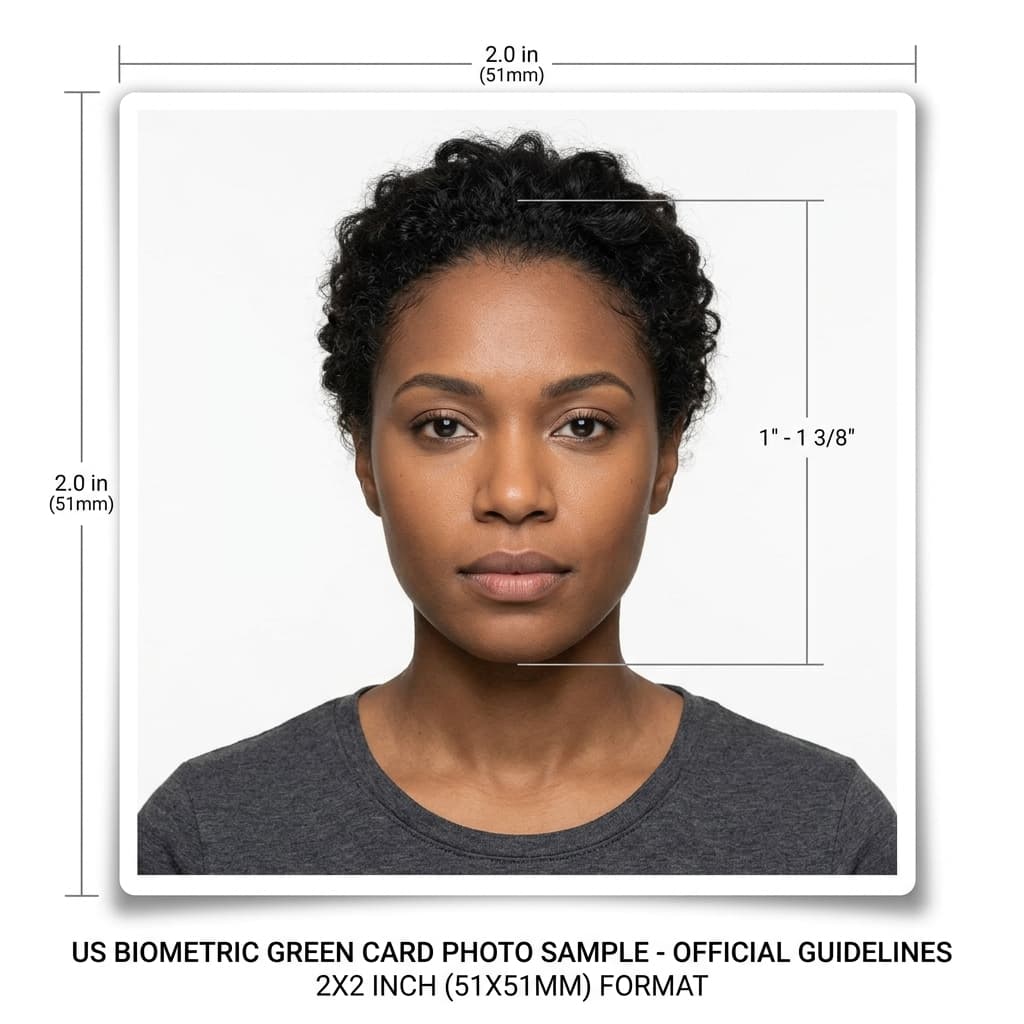
The most reliable validator for I-485, DS-260, and I-90 biometric photos. Guaranteed 2x2 inch (51×51mm) compliance for USCIS and Department of State applications — head size 50-69%, eye position 56-69%, and pure white background.
Stand against a plain white wall, 3-4 feet away. Natural window light is best. Camera at eye level, neutral expression.
02
⬆️
Upload to Validator
Select your photo — our AI instantly analyzes dimensions, head size, eye position, and background purity.
03
🤖
AI Biometric Check
Our system validates against all 10+ USCIS requirements and provides a detailed PASS/FAIL report.
04
📋
Review Compliance Report
See exactly which specs passed and what needs fixing — with specific guidance for each issue.
05
✅
Download & Submit
Pay $5.99 to unlock your processed photo — ready for I-485, DS-260, or I-90 submission.
Guidelines by Form
Compliance for All Green Card Applications
Whether you're adjusting status, applying from abroad, renewing your card, or removing conditions — our tool ensures compliance.
FORM I-485
Adjustment of Status
2 identical color photos required when adjusting to permanent resident status while in the United States.
Submit with Form I-485, I-765, and I-131 applications.
FORM DS-260
Consular Processing
Photos for immigrant visa interview at US embassy abroad before entering as permanent resident.
Digital upload required for online DS-260, plus physical copies for interview.
FORM I-90
Green Card Renewal
New photos required every 10 years when renewing your permanent resident card.
Submit 2 identical 2x2 inch photos with your I-90 application.
FORM I-751
Remove Conditions
Updated photos to remove conditions on 2-year conditional residence (marriage-based).
Joint filing requires 2 photos of petitioner and 2 of spouse.
👓 Green Card Photo — No Glasses Policy
Effective November 1, 2016, the U.S. government implemented a strict No Glasses policy for all immigration and visa photos. This is the #1 reason for green card photo rejection and RFEs. The only exception is a documented medical necessity with a signed statement from a licensed practitioner.
Avoid RFEs
Top 5 Reasons Green Card Photos Get Rejected
According to USCIS data, these 5 issues cause the majority of Request for Evidence (RFE) notices.
#1 Rejection Reason
Incorrect Head Size
Head height must be 50-69% of total image height (1-1 3/8 inches on 2x2 print).
🔧 How to Fix: Adjust camera distance — head too small = move closer, head too large = move farther away.
#2 Rejection Reason
Wrong Eye Level Position
Eyes must be positioned between 56% and 69% from bottom of photo.
🔧 How to Fix: Ensure camera is at exact eye level and subject is looking directly at lens.
#3 Rejection Reason
Non-White Background
Off-white, cream, gray, or shadowed backgrounds fail USCIS RGB color check.
🔧 How to Fix: Stand 3 feet from a pure white wall. Use our AI background replacement if needed.
#4 Rejection Reason
Wearing Glasses
All eyeglasses prohibited since November 2016 — #1 reason for RFEs.
🔧 How to Fix: Remove glasses completely. Medical exceptions require signed doctor's statement.
#5 Rejection Reason
Poor Image Quality
Blurry, pixelated, or over-compressed images fail biometric extraction.
🔧 How to Fix: Use highest quality camera setting. Ensure good lighting and steady hands.
DIY Photography Guide
How to Take a Green Card Photo at Home
Professional tips to get a USCIS-compliant photo using just your smartphone.
💡
Perfect Lighting Setup
Face a large window during daytime hours. Turn off all indoor lights to avoid yellow/blue color casts. No flash — it creates harsh shadows and reflections.
📏
Camera Distance & Angle
Place camera at eye level, 4-5 feet away. Have someone take the photo — selfies distort facial proportions and are rejected by USCIS.
👔
What to Wear
Wear everyday clothes you normally wear. Avoid uniforms, camouflage, white shirts (blend into white background), or busy patterns.
🚫
Remove Accessories
Take off glasses, hats, headphones, and large jewelry. Hair should not cover eyes, ears, or face.
💄
Makeup & Grooming
Natural makeup only. Avoid heavy contouring, glitter, or shiny products that create glare. Facial hair should be as normally groomed.
👶
Baby & Infant Photos
Lay baby on a plain white sheet. Take photo from directly above. No toys, pacifiers, or other people in frame.
🧠
Automated Facial Recognition
When you submit Form I-485, your photo is digitized and run through the USCIS facial recognition system. This system measures over 12 unique facial landmarks (distance between pupils, width of nose, etc.). If your photo has soft focus or uneven lighting, the system cannot extract this data, leading to a Request for Evidence (RFE).
📸
Form-Specific Formatting
Whether it's the DS-260 for consular processing or the I-90 for card renewal, the requirements are standardized but the submission methods vary. Our tool provides both a 600x600px digital file for online uploads and a printable 4x6 template (containing two 2x2 photos) for physical mail-ins.
Official Sources
Direct Links to USCIS & Government Resources
Our standards are sourced directly from official U.S. government agencies. Always verify requirements before submitting.
ℹ️ This tool is independent and not affiliated with, endorsed by, or operated by USCIS, the U.S. Department of State, or any U.S. government agency.
Frequently Asked Questions
Common questions and issues people face with US Green Card applications.
What size is a green card photo?
Green card photos must be exactly 2x2 inches (51x51 mm) for printed photos, or 600x600 pixels for digital uploads. The head must measure between 1 inch and 1 3/8 inches from chin to top of head, occupying 50% to 69% of the total image height.
Can I wear glasses in my green card photo?
No. Since November 2016, the U.S. State Department and USCIS prohibit wearing any type of glasses in green card or visa photos. You must remove them even if you wear them daily.
How many photos do I need for Form I-485?
When submitting Form I-485 (Adjustment of Status), you must provide two identical color passport-style photos taken within the last 6 months that meet all official biometric requirements.
Why might my green card application be blocked if an American applies for the job?
Under the PERM labor certification process, employers must prove they cannot find a qualified, willing, and available US worker for the position. If an American citizen or permanent resident applies and meets the minimum requirements, the employer cannot proceed with sponsoring a foreign worker.
How does criminal history affect the approval of a green card?
A criminal history can lead to green card denial, especially for crimes involving moral turpitude (CIMT) or aggravated felonies. Even minor offenses or dismissed charges must be disclosed and can trigger extensive scrutiny, potentially requiring specialized waivers depending on the conviction.
What happens if there are blanks on my medical report for the green card?
Any blanks or incomplete sections on the Form I-693 medical report will likely cause USCIS to issue a Request for Evidence (RFE), significantly delaying your application. You must ensure the civil surgeon accurately completes, signs, and seals every section before submission.
Why do background checks sometimes delay green card interviews?
USCIS conducts comprehensive background checks involving the FBI and other agencies to verify your identity, criminal record, and immigration history. Name matches, complex travel histories, or security clearances can cause these checks to pend indefinitely, delaying your interview scheduling.
How can unauthorized work impact my green card eligibility?
Unauthorized employment is a serious violation that generally bars adjustment of status. However, certain exemptions exist, such as Section 245(k) for employment-based applicants (foraging less than 180 days out of status) or marriage to a US citizen, which pardons unauthorized work.
What to do if my green card is rescinded after time abroad?
If your green card is challenged upon reentry due to extended absences (over a year), do not sign Form I-407 to voluntarily surrender it. Instead, request a hearing before an immigration judge where you can argue that your absence was strictly temporary.
Why are green card applications denied due to fraud or ineligibility?
USCIS denies applications for fraud if they discover you lied, used fake documents, or entered a fraudulent marriage to gain immigration benefits. Material misrepresentation carries a lifetime ban from the US. Ineligibility occurs when you simply do not meet the legal criteria for the specific visa category.
How long can the green card process take for professionals?
The employment-based green card process can take anywhere from 2 to over 15 years, depending heavily on your country of birth (due to per-country caps) and your preference category (EB-1, EB-2, EB-3). The prevailing wage and PERM stages alone add over a year.
What documents are essential for a successful green card petition?
Essential documents include a valid passport, birth certificate, marriage certificate (if applicable), proof of lawful entry (I-94), medical exam (I-693), and category-specific evidence like an approved I-140 petion for employment, or proof of a bona fide marriage for family-based applications.
Why might an employer refuse to file PERM due to too many US applicants?
Filing a PERM certification requires a good faith recruitment effort. If an employer anticipates or receives a high volume of qualified US applicants for the role, the U.S. Department of Labor will deny the certification, rendering the costly and time-consuming PERM process futile.
How does lying on immigration forms affect green card status?
Lying or misrepresenting facts on immigration forms is considered fraud. If discovered, even years later, it can lead to immediate green card revocation, deportation proceedings, and a permanent bar on returning to the United States.
What steps are involved in applying for a green card without a lawyer?
Applying without a lawyer involves determining your eligibility category, carefully completing the correct forms (e.g., I-485, I-130, I-140), gathering required supporting evidence, paying the exact filing fees, attending a biometrics appointment, and preparing thoroughly for the final USCIS interview.
Why do some green cards get denied for missing interviews?
Missing your scheduled green card interview without prior notification or a valid emergency reason results in immediate denial for 'abandonment' of your application. Always attend; if you absolutely must reschedule, do so properly through USCIS well in advance.
How can insufficient financial support lead to green card denial?
Family-sponsored applicants must have a sponsor who submits an Affidavit of Support (I-864) proving income above 125% of the poverty guidelines. If the sponsor's income is insufficient and no qualified joint sponsor is provided, the application will be denied under the public charge rule.
What health issues might cause problems in green card applications?
Health issues categorized as Class A conditions can lead to denial. These include communicable diseases of public health significance (like untreated tuberculosis or syphilis), failure to provide required vaccinations, and physical or mental disorders associated with harmful behavior.
Why are prior immigration violations a barrier to green cards?
Prior violations, such as overstaying a visa by more than 180 days or entering the US illegally, trigger 3-year, 10-year, or permanent reentry bars. These statutory bars prevent you from adjusting status to a green card unless you qualify for and obtain a specific waiver.
How to handle recruitment phases where Americans apply and block the process?
If qualified Americans apply during the PERM recruitment phase, the employer cannot proceed with your case for that specific role. The employer must pause the process and try again later, or place you in a different role with higher, more specialized requirements.
What to do if my green card is dropped after the job ad phase?
If your PERM fails during recruitment, work with your employer to evaluate the reasons. You may need to restart the process with a revised job description that accurately reflects higher necessary qualifications, or explore alternative visa pathways like an O-1 or NIW.
Why do mass PERM filings get paused in shifting labor markets?
During economic downturns or mass layoffs, the Department of Labor heavily scrutinizes or halts PERM approvals for specific occupations. Employers cannot sponsor foreign workers if they have recently laid off US workers in the same or closely related occupations.
How can I prove strong ties for a green card application?
Unlike nonimmigrant visas, green card applications inherently demonstrate immigrant intent, so proving 'ties' isn't required in the same way. Instead, you must prove the legitimacy of your relationship with your sponsor, whether it's a genuine marriage or a bona fide employment offer.
What are the risks of incomplete forms in green card submissions?
Submitting incomplete forms, missing signatures, or failing to include mandatory initial evidence will result in immediate rejection or a Request for Evidence (RFE), causing significant delays in processing times and potentially risking your underlying legal status.
Why might a green card be revoked if violations are discovered later?
Green cards can be revoked if USCIS uncovers fraud during the initial application, if you commit serious crimes making you deportable, or if you abandon your US residency by living abroad permanently. Approvals are never strictly final if obtained unlawfully.
How does absence from the US affect existing green card status?
Continuous absences over 6 months raise questions about your intent to reside in the US. Absences over 1 year generally break the continuity of residence for citizenship and act as an abandonment of your green card, requiring a Re-entry Permit or SB-1 visa to return.
What professional routes exist for green cards besides school?
Beyond student-to-worker paths, professional routes include employer sponsorship (PERM), National Interest Waivers (NIW) for individuals whose work benefits the US, EB-1 classifications for those with extraordinary ability or multinational managers, and the immigrant investor program (EB-5).
Why is the green card journey described as not easy?
The green card journey is complex due to convoluted immigration laws, multi-year backlogs for certain countries, strict documentary requirements, the reliance on continuous employer sponsorship through shifting economic conditions, and high filing fees, creating a stressful and uncertain experience.
Ready for Your Green Card Interview?
Ensure your application isn't delayed by a simple photo error. Use our official USCIS validator now — get your free PASS/FAIL report in seconds.